Monday, December 7, 2020

Turkey's Alevis & Myths of the Mountain Goats

 I came across this treasure at Middle East Eye & realized if I didn't save it at my blog it might vanish into the bottomless web archives. There are more images at the link and hyperlinks are the same.

~~~~

Turkey's Alevis and the myths of the mountain goats

Turkey’s long-oppressed Zaza Alevi minority have a mystical connection to nature, especially the sacred mountain goats of Dersim

By Nick Ashdown in Dersim
7 December 2020 10:19 UTC


Ali Ekber Frik, a 74-year-old dede, or spiritual leader, tells an old story in a low, raspy voice, his plump fingers playing with prayer beads. He’s in Ovacik, a small town in Turkey’s Tunceli province, known by locals as Dersim, in eastern Anatolia.

Behind him a shepherd watches over his flock of sheep near a graveyard as the late afternoon sun envelops green rolling hills in its warm glow.

“Perhaps 150 years ago, three people came from Kemah [a nearby town] to the foot of the Munzur Mountains, and they were very hungry,” he says.

“Seeing a fire in a cave, they approached and saw that four or five people had butchered a mountain goat, and were waiting as it cooked. The travellers said: ‘We are very hungry, we came here for a piece of bread, but we don't eat mountain goat and if you ask us, you shouldn't either,’ and they immediately left, even though they were starving.”
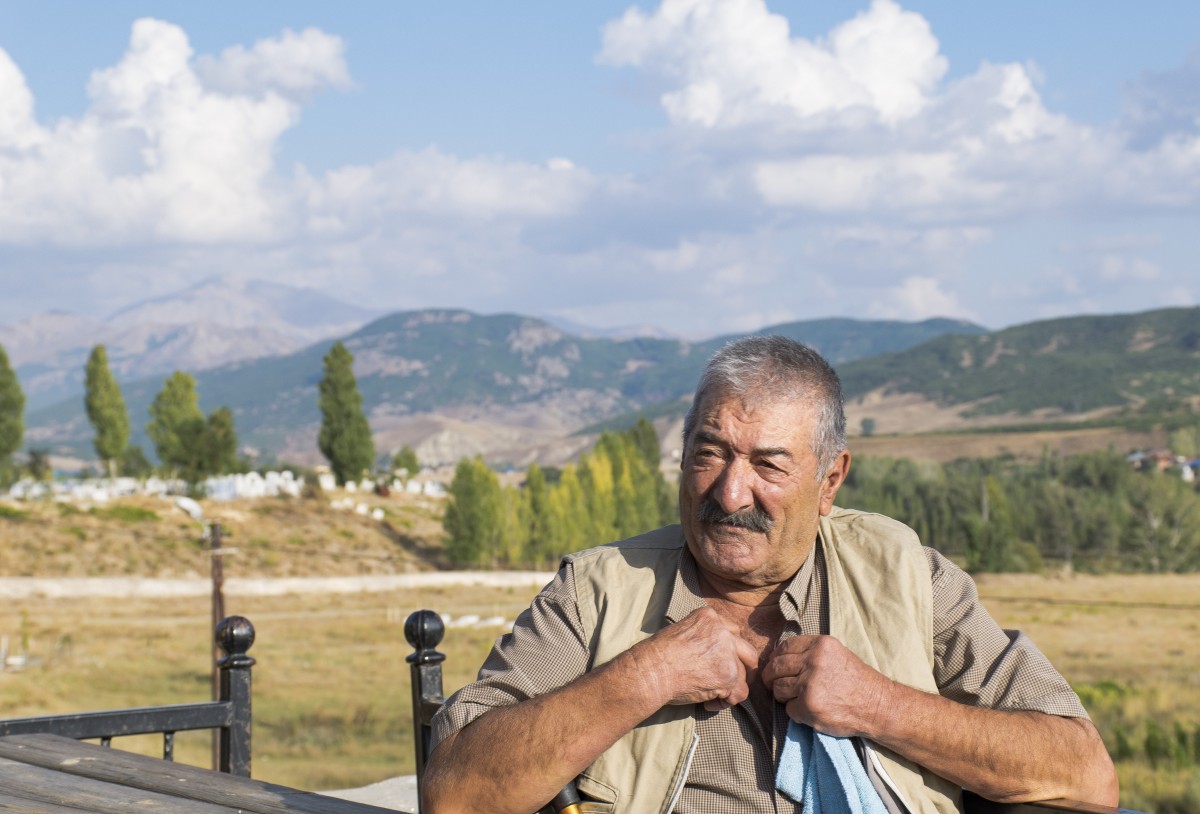
Ali Ekber Frik explains the significance of Dersim’s
mountain goats in Ovacik, Turkey
(MEE/Nick Ashdown)

The travellers, like Frik, were Alevis, Turkey’s largest religious minority, and they consider the mountain goats sacred. Dersim is chiefly inhabited by a long-persecuted people who are a minority of a minority.

They are Zaza Kurds, otherwise known as Kirmanc, speaking a dialect different from Kurdish peoples found elsewhere in Turkey and the region. Their form of Alevism is also different from that followed by the related Bektasi Alevis, who are ethnically Turkish and have been more influenced by Shia Islam.

Ferociously independent, Dersim was never fully under government control until an uprising in 1938-39 was crushed by the state.Alevis suffered repression, surveillance and massacres under the Sunni Ottoman sultans who considered them heretics.

These same mountains that protected the Zaza Alevis before the advent of modern warfare became the site of their massacre. Soldiers dropped bodies from cliffs into the Munzur River and lit fires at the mouths of sealed caves, sucking the oxygen out of the people trapped inside.

They consider not just mountain goats, but all living things sacred, and all things that contribute to life, such as the sun and water. They worship nature itself. Older generations in Dersim say prayers to the sun and moon, but they say this practice is now being lost.

The Zaza Alevis’ heterodox, mystical belief system known as Raa Haqi, was influenced by pre-Islamic Anatolian shamanistic practices, Zoroastrianism, Buddhism, Armenian Christianity, and only later by Shia Islam. Unlike most members of Turkey’s other Alevi communities, many Zaza Alevis reject the label of Muslim.

Dersim, particularly in the Munzur Valley National Park, has the most diverse ecosystem in Turkey. The Park is teeming with over 1,500 plant species, 43 of which are endemic, and is home to animals such as the brown bear, Eurasian lynx, wildcat, gray wolf, and wild boar.

“We call mountain goats, honey bees, and weasels in the mountain sacred. Because they don’t harm anyone, they are sacred. We don't kill them,” explains Frik.

To show the value of nature in their beliefs, he recites an old poem about the sacredness of trees, and the role that wood has played in holy objects, such as the cradle of the Kaaba (the holiest site in Islam) or the saddle of the Imam Ali, whom Alevis revere.

“That is how much we value trees, since time immemorial, and the trees love us back. Even though our forests burn, they never give up on us,” Frik says. Turkey, as elsewhere in the world, has experienced an uptick in forest fires due to climate change.

This reverence for nature is why Dersim residents are so disturbed by the hunters who sometimes come to take their sacred mountain goats as trophies. The goats, some species of which are endangered, are protected by Turkey’s Ministry of Forestry and Water Affairs, but the government says older animals are allowed to be hunted in limited quantities, and that 60 per cent of the money earned from the tenders goes back to local villages.

This past summer, activists launched a campaign to ban mountain goat hunting in the region and the Dersim Cultural and Natural Heritage Conservation Initiative filed a lawsuit requesting cancellation of the tenders. The ministry responded by suspending a tender it had opened to hunt 17 goats, and promised to conduct an investigation, taking into consideration local customs and beliefs.

Local environmentalists don’t particularly care whether the hunting is done legally or not, they are horrified by it, and want it forbidden without exception. “We’ve watched as killers coming from outside the province and from different European countries hunt Dersim’s most important species,” said activist Hasan Sen of the organization Munzur Protection. “The authorities close their eyes to massacres.”

‘The property of saints’

For the Alevis, killing such holy creatures isn’t just senseless and immoral, but a dreadful sin. Transgressors are traditionally outcast and labelled as duskun, or "fallen". “In the old days when people did this, they would be sent into exile,” says 68-year-old dede, Zeynel Batar, in the village of Kedek.

“There was a guy in our village who’d go after the mountain goats. We warned him many times not to. One day he plunged off the rocks and died. They didn't even wash his body in the square.”

Though Zaza Alevis consider all wild animals holy, mountain goats, of which there are several local varieties, are especially sacred. “They are the property of saints,” Batar explains.

“These goats eat special grass but when it’s wintertime the mountains are full of snow and what do they eat? Their food comes from the unknown, brought by the saints.”

Three mythical saints are said to be the goats’ shepherds - Sarik Sivan, Sıx Ahmet Dede, and Duzgun Baba. Duzgun - which might be a Turkicised version of a Zaza word meaning sharp rocks or cliffs - is the most famous of them.

On Duzgun Baba mountain, near the town of Nazimiye, 27-year-old dede Kaya Celik climbs the stairs carved into the mountainside and recalls the legend of the holiest of the shepherd saints.

Though there are many versions, according to most, Duzgun’s original name was Sah Haydar, and he was the son of an important religious leader, Kures Baba. Haydar was known for having well-fed goats, even in the winter when food was scarce, and this made his father curious.

“One day, Kures Baba follows his son and the flock and sees that when Haydar touched the oak trees with his staff, the trees would turn green. This was a miracle! When his father sees this, he is both proud but also shocked that his son has surpassed him,” Celik says.

But then, one of Sah's sheep picks up the scent of the shepherd’s father and sneezes. Sah Haydar chuckles and says, “What’s wrong little sheep, did you smell my dad Kureso Khurr?”, using a nickname with which a son shouldn’t call his father in a culture where elders are revered. He turns around, and seeing that his father really is there, leaps to the top of the mountain in shame, disappearing into another realm. After that, he was remembered as Duzgun Baba, and the mountain bears his namesake.

“A couple of animals followed Sah, and his father brought the rest of the flock down. We believe that the goats wandering around this mountain right now are those that followed Duzgun Baba, and are therefore divine,” Celik says.

Higher up on the mountain, past the Alevi shrine, or ziyaret, with a fountain pouring ice-cold water into the mouths of grateful pilgrims, a young man named Murat Babayigit nimbly scales across the jagged rock surface, pointing to a very narrow cave, just large enough to crawl through.

“Duzgun Baba’s bed is in this cave,” Babayigit says. “It’s a sacred place. You feel content up here, happy.”

Still higher, at the very top, lies Duzgun’s grave, a large pile of grey stones, surrounded by various smaller cairns. The sun and moon - both sacred to the Alevis - are presiding together over opposite ends of the early evening sky.

Powerful bond


The endless, jagged mountains seen from here have protected the people of Dersim and other marginalised communities for hundreds of years during various waves of persecution.

In the 1990s, thousands of villages and hamlets in over a dozen provinces in the east and southeast were emptied and scorched by the military, in government operations against the armed Kurdistan Workers' Party (PKK).

The Turkish interior ministry later launched a project to return Kurds to their homes, called the "Return to Village and Rehabilitation Project". The government-funded project ran from 1999-2015 at a cost of 200m Turkish lira, which at the time was the equivalent of $72m, but was criticised as ineffective by Human Rights Watch.

According to the Interior Ministry, during the fight against the PKK, 62,448 houses were emptied and 386,000 people were forced to emigrate. Now just 28,834 houses are occupied by the people who used to live in them. A total of 187,000 people returned to their villages in 14 provinces, including Dersim.

Over the years, sporadic tensions and clashes have been reported in the province - in 1994, six teachers in Dersim were killed by PKK fighters. Last year during clashes between the PKK and the Turkish military, one soldier was killed and three others wounded.

But this long history of unrest has only strengthened the people’s bond to the land, the animals and each other. “Alevis went to the mountains to run away from tyrants, and when they got there, they saw the mountain goats,” Frik said.

“Every time we go there - when we take our flocks there, when we plant garlic, when we pick mushrooms - we are together.”

Saturday, December 5, 2020

Umair Haque -- American Democracy’s Broken Because Minorities Have to Keep Saving It From White People

American Democracy’s Broken Because Minorities Have to Keep Saving It From White People

In case you hadn’t noticed, yesterday, Donald Trump posted a 46-minute long video demanding that the election results be “overturned…now!” That came shortly after Bill Barr admitted that Trump’s attempts to legally tamper with results were both baseless and absurd — and the Attorney General is a die-hard Trumpist if ever there was one.

So why is Trump persisting with his coup? Hasn’t it failed? 
Well…yes. But also…no. Coups can succeed or fail on several levels. And Trump might not have walked away with the ultimate prize — but he’s not walking away empty-handed, either. The proclamations of the outright triumph of American democracy are premature.

It’s true that Trump’s coup has failed at any coup’s primary goal, which is to seize power. Trump’s legal challenges have mostly all been thrown out, by dumbfounded and irate judges, no less. For Trump, losing a crony like Bill Barr is like the first mate of the Titanic heading for the lifeboats. His electoral college tampering is looking increasingly unsuccessful, too. The reality, at this point, is that Trump isn’t going to be in power for another term.

Not now, that is.

Yet Trump’s coup has been remarkably successful on two other levels. 
Levels which themselves have torn a hole in the already tattered fabric of American democracy. He’s accomplished something as ugly as it is bizarre as it is ominous.

The first level on which Trump’s coup has succeeded is with the Republican base. 
70% of Republicans believe the election was rigged. That’s not just a majority — it’s a massive supermajority. That’s not, say 50.1% of them, which would be bad and sinister and foolish enough. It’s 7 out of 10 of them.

Who are Republicans, anyway? Well, here I have to share a truth with you that’s funny, ugly, telling, and…you’re not going to like it. Republicans are white people who like to lie because they’re ashamed of being Republicans. I know that sounds harsh, so let’s look at some basic statistics together. 51% of White voters say that they “lean Republican.” That seems like a pretty even split, right? But the problem is that they’re not telling the truth. Over the last fifty years, an average of 55% percent of white people have voted Republican in every electiono. No Democrat — not one, from JFK to Obama — has ever won a majority of white voters.

So to say that “70% of Republicans believe the election of rigged” is, more accurately, to say this: 55% of white people voted for Trump, the precise historical average, and 70% of that 55% believe that the election was rigged. That’s not an outright majority of whites — but it’s pretty close. It’s a massive, massive number of Americans. How many, to be precise? Well, you can simply put the number at about 70% of the Trump vote. That’s at least 52 million people.

Now, it’s worth bearing in mind the context for all this. It’s not as if the last four years have been…normal. They have been the worst four years in modern American history, by a very long way. First, there was the fascism…the concentration camps, Gestapos, purges, (actual) Nazis, “family separations,” and so on. Then there was the failure even for “real” Americans, whose incomes fell, suicide rates soared, and mobility cratered, as America became a nation of poor people. Finally, there was what fascism and stupidity and hate and ignorance tend to result in, which is mass death. How many Americans are dead of Covid today? Two hundred and seventy four thousand.

That’s the context in question. To call Trump’s Presidency a failure is the understatement of the century — yes, really. 
America has the worst Covid outcomes in the world. And it’s exploding all over again. And yet 70% of Republicans, most of whom are white people, believe that the election was rigged…against the worst President in American history…the worst leader on the face of the globe, apart from maybe the kinds dictators of failed states Trump longs to be. (That’s not just my opinion, by the way, but from 200 political scientists.)

Think about that for a moment. Because when these “voters” say “the election was rigged!” they’re also saying: “None of the above matters to me. Not the mass death from Covid, not the fascism, not the kids in cages, not even the skyrocketing suicide rate amongst the only people I consider to be ‘real’ human beings, white people. None of that matters. I don’t care!”

So what does matter to them? Their political preferences and priorities are crystal clear by now. Here’s what Republicans don’t want. Any kind of public goods, from public healthcare to higher education to retirement — that’s not so odd, by the way, because even Democrats don’t want that. That’s troubling enough — that both sides in American politics agree it shouldn’t be a modern, functioning society.

But what’s really ominous is how far backward Republicans want to rewind the clock of modernity. To the Wild West? This faction believes that carrying a gun is the right that matters most. To the Taliban? Sure: that faction believes that religious law should rule civil society. To… Handmaid’s Tale? Sure: Amy Coney Barrett, Justice of the Supreme Court, belongs to a fanatical religious sect in which men make all the decisions, and there’s no separation between private and public life, which, if Americans saw it in a Muslim country, would be called something like “Iran.”

Even democrats don’t think America should be a modern, functioning society, like Canada or Europe. That’s why Liz Warren and Bernie Sanders didn’t win the primaries then — and are being loudly, publicly snubbed by Biden now. But Republicans go way, way further than that. They seem to believe — genuinely, in a heartfelt way — that America should be some strange cocktail of a fascist state, a theocracy, and an apartheid state. They seem to want to create a medieval dystopia, where women have few rights, minorities are hated subhumans, the chosen people carry guns everywhere, and purity of faith and blood are what decide a person’s fate and destiny.

(We minorities call that “Hillbilly Elegy.” That’s a joke. If you get it, you get it.)

In that context, Trump’s coup has been super successful. 
Republicans — meaning American whites have never wanted to live in a modern democracy. They have voted, historically, as a social group — meaning a majority of whites — and as a political bloc — meaning “Republicans,” which is what they call themselves to put a polite gloss on “white people” — against all the following things: civil rights, women’s rights, gay rights, desegregation, public education, healthcare. The list goes on and on and on.

Let me distill that.

“Republicans” is a euphemism for “white people,” and as a social group and political bloc, American white people have, in their majority never — never wanted to live in a modern democracy. A society of equals, where minorities and women and so forth have the same rights as everyone else, a truly free society, where everyone has the basics, a society that’s fair and just, where everyone is treated with dignity and gentleness and respect. They have never wanted to live in such a place.

Never. Not since the days of JFK — who eked out a narrow win, thanks to minorities — right down to now.

What Trump has done is give license to white people — aka “Republicans” to openly stop believing in democracy. 
See the process of decay: during the Reagan Revolution, American whites had to at least pretend to pay lip service to democracy, and so, too during the Bush years. But now they don’t. Trump has let them openly begin to state what they have always really believed and voted for — against democracy, because a modern, functioning society wasn’t something they ever wanted to have.

Basically, if you look at the numbers, maaaybe about 25% of Republicans aren’t white. 
What a coincidence! That’s roughly the same number that believes the election wasn’t rigged. White people are still 77% of America. It’s a very, very bad thing when 70% of a political side —almost entirely made up of a single ethnic group, which is a society’s majority —openly stops believing in democracy, just because they didn’t get what they wanted. Which, incidentally, was less democracy in the first place.

If we saw all this happening in another country, what would we call it? What would we say if, for example, 70% of conservatives in a Muslim country thought an election was rigged because it didn’t result in dictatorship and authoritarianism — coincidentally, the same 70% who hated other religious groups? If, for example, 70% of one kind of ethnic group, the majority, who hated the rest, stopped believing in democracy, just because they’d lost an election in which they sought the right to repress and subjugate everyone else even harder? We’d call it what it is: a racist meltdown. A social collapse made of bigotry and hate.

That is still where America is.

Yes, Biden won the election. But it was a Pyrrhic victory. 
It revealed just how racist, bigoted, and frankly idiotic the vast majority of American white people really are. They didn’t seem to care about the horrors of the last four years, they gave all that a free pass, if not cheering encouragement, and then when they didn’t get the right to inflict more damage on everyone, including themselves, they threw a massive baby tantrum, and threw all the toys out of the crib.

Biden’s victory is a vivid demonstration of just how broken America really is. Minorities won the election for Biden — a story that white pundits aren’t telling because they don’t want it told. They’re telling the opposite story — of a handful of minority communities in which Trump’s support, predictably, increased. Like Cuban exiles, who lean arch-conservative. So what? The larger story —and the truer one — is that minorities saved America from fascist collapse.

But let me tell you something you probably don’t know.

That’s what they’ve been doing for half a century now.

Who gave JFK his historic victory? Minorities did. And without that, America would probably never have had desegregation. Remember — whites have never voted for a Democrat as a majority. If American whites had had their way, if their preferences had prevailed, America would still be a segregated society. To this very day.

Stop and think about that for a second. It’s chilling and eerie to us minorities, and it should be to you, too.

Let me put all that much more bluntly.

Minorities have been saving white America’s stupid ass from authoritarian fascist collapse for half a century now.

And at every step of the way, American white people have resisted. They have refused to learn a damned thing. They have voted, over and over again, to keep democracy as limited and backward a franchise as humanly possible. As a social group, in their majority, they have never wanted anything but what Trumpism has promised them.

America’s white people are it’s biggest problem. They do not live in the modern world, and they don’t want to.

Trump’s coup has been massively successful in that regard. It has taught white Americans that they can keep on pulling backward, resisting the arc of history, the gravity of modernity, that they can keep on hoping to live in a backward, medievally ignorant, broken, crushingly poor, authoritarian society — as long as they get what they always wanted: supremacy.

That’s no small feat. Maybe it was always on the cards, if you understand the cruel history I’ve tried to tell above. And it doesn’t bode well for the future. Because either Trump is going to run again, or his kids will run, or someone even more stupid and evil and grotesque will. Before you ask if that’s possible, go ahead and imagine President Ted Cruz, or President Tom Cotton.

A nation cannot survive, often, when it has become like America. 
When its majority hates everyone else, because it hates the idea of everyone else being a person, being a human being, being free and equal, pursuing life and liberty and happiness, because what it really wanted, all along, was to be above them, dominating them, enslaving them, owning them. And if it can’t have that, it won’t accept any kind of social compact at all.

That is the perilous place America finds itself in. Just a tiny number of minorities less, the ones who’ve saved its ass from total implosion for the last fifty years, and America would be even more of a third world country than it is now. An authoritarian state, and probably an apartheid state to boot, not to mention vastly poorer. Its white people, as a majority, appear to be every bit as ignorant, remorseless, and cruel as the majorities in, say, Iran or Saudi Arabia. If they can’t have it all — they don’t want anyone to have anything at all. There is no social contract they will agree to whatsoever, which is what “Wahhh! The election was rigged! I don’t believe in democracy!” really means. American white people have nothing in common — nothing whatsoever — with their cousins in Europe or Canada, who agree happily to modern social contracts where everyone has the basics, and then plenty beyond that, no matter their color, race, or creed.

America’s white people seem to truly be different — deeply, gruesomely so. They never accepted modernity and democracy. And they still don’t.

Umair
December 2020

Thursday, November 19, 2020

Jonathan Pie on Donald Trump

Jonathan Pie is a fictional character created and portrayed by English comedian Tom Walker. A political correspondent, Pie appears in a series of online videos in which he rants and explodes in anger about the state of British, American and Australian politics, with the videos being presented as though he were a real reporter speaking his personal opinions to the camera before or after filming a regular news segment.


Monday, November 16, 2020

Replacing rentier capitalism is one of the defining challenges of our age


*** Backup copy for future reference. ***

Replacing rentier capitalism is one of the defining challenges of our age

Two new books reveal how our economy is increasingly oriented around the interests of asset owners – and increasingly uncaring about the fates of everyone else.
Christine Berry
6 November 2020

As the COVID-19 crisis grinds on, it’s increasingly clear that the UK’s broken economy – an economy based on the extraction of rent – is deepening the pain. In August, people were prematurely cajoled back to the office, amid rising panic at the ‘hollowing out’ of city-centres built on inflated commercial property values. In September, students were herded back into overcrowded university accommodation, which duly became the epicentre of the second wave. Many suspected that this predictable disaster was allowed to unfold at least partly because of the dependence of universities and private landlords on rental income from student halls.

Meanwhile, the divide between private renters and homeowners yawns ever wider. While buy-to-let landlords have been able to access mortgage holidays, their tenants struggle with escalating rent debt. Social movements are gearing up to resist evictions after the temporary ban was lifted. While the government’s stamp duty holiday has helped house prices to bounce back, there is no sign whatsoever that jobs and living standards will do the same.

Housing itself is just the most egregious tip of a very large iceberg. Everywhere you look, COVID-19 is widening the gulf between those who own assets and those who owe debts. Buoyed by central bank interventions, capital markets have seen the promised ‘V-shaped recovery’ – but for everyone else, this is now a distant fantasy. Our economy and our politics seem increasingly oriented around the interests of asset owners, and increasingly uncaring about the fates of everyone else.

Vast sums are siphoned off to failing private providers – including £12 billion for our disastrous test-and-trace system – while government quibbles over the relatively tiny amounts needed to ward off outright destitution (£65 million for Greater Manchester to weather its local lockdown, £21 million a week to feed hungry children). Rishi Sunak might be trying to revive the old chestnut that “there is no money left”. Yet increasingly, people are beginning to suspect that the problem isn’t the amount of money available, but where that money goes. This is intimately bound up with the question of where power lies.

Two very different new books aim to help build our understanding of this landscape, and how we can navigate it to build a new economy. ‘Rentier Capitalism’ by geographer Brett Christophers (out on 17 November from Verso Books) is a serious and detailed study of how the UK economy became dominated by rent extraction. What does this mean? Christophers combines the orthodox economic understanding of ‘rent’ – essentially, excess profits beyond what would be achieved in a competitive marketplace – with the heterodox understanding, which focuses on ownership and control of assets.

Accordingly, he defines rent as “income derived from the ownership, possession or control of scarce assets under conditions of limited or no competition”. It’s debatable how much is really added by the orthodox emphasis on competition – or whether it’s entirely coherent to mash up heterodox and orthodox analytical frameworks in this way. But, leaving these theoretical debates aside, the real heart of Christophers’ argument – and what makes this book so important – is the emphasis on ownership.

Christophers meticulously documents how the ‘commanding heights’ of the UK economy – its most successful sectors, from finance and property development to pharmaceuticals and utilities – are all riddled with rentierism. Most intriguing is a chapter on ‘contract rents’, in which he argues that the entire outsourcing industry is a textbook example of rentier capitalism. The likes of Serco, he argues, are not experts in actually doing anything. They are experts in winning government contracts – essentially, monopolies on the delivery of public goods, which provide guaranteed flows of income (rent) for years or even decades. These contracts are the assets on which their shareholder value is based.

One might be tempted to respond that a contract to deliver a service feels somehow different from, say, a piece of land or an energy resource: the former is, at least in theory, a reward for work, while the latter is simply a gift from nature, allowing the lucky owners to profit with no work whatsoever. This is a much more clear-cut case of unearned rent. Yet recent events have given Christophers’ argument a new relevance. Watching Serco’s profits soar as its calamitous test-and-trace system crumbles around our ears, the extractive nature of its business model has been laid bare for all to see.

Christophers’ dual emphasis on asset ownership and low competition also illuminates how we got into this mess, and the nature of the system we need to change. He argues that neoliberalism was never really about free markets, as is often assumed: it was about private ownership. In this respect, the rhetoric of neoliberalism never matched the reality. Markets for the control of assets were massively expanded by neoliberalism, through processes such as privatisation. But this was never accompanied by any serious efforts to promote competition in those markets. Instead, successive governments allowed ownership and control of assets to concentrate in the hands of a small number of big players.

One partial exception to this was housing, where the Right to Buy ‘bought in’ large swathes of the middle classes to this economic model. This helps to explain why it has endured politically for as long as it has. As Keir Milburn argues in ‘Generation Rent’, it also helps to explain why that political consensus is now fracturing along age-related lines, as young people are locked out of the housing wealth accumulated by their forebears. Or, as Christophers puts it: “Nothing today bespeaks exclusion from the ‘common wealth’ more than being locked out of home ownership – and nothing bespeaks the likelihood of remaining excluded more than paying half of one’s income in rent.” Without fundamental change to the UK’s economic model, these divisions will surely only continue to grow.

‘Rentier Capitalism’ does not have much to say about what this change should look like – although it does end with a few pointers. But then, this is not really a book about solutions. It is a careful and compelling argument about the nature of the problem, an important and urgent contribution to our understanding of modern capitalism. Yet its analysis raises the question: if our entire economy is structured to concentrate wealth and power in the hands of an ever-shrinking ownership class, how can we hope to challenge this power effectively? It is this question that concerns the authors of ‘Unions Renewed’, Alice Martin and Annie Quick (out now from Polity Press).

This is a much shorter, more accessible affair – but it packs an impressive breadth and depth of thinking into its 140 pages. It argues that the changing nature of capitalism – specifically, the rise of financialisation and rentierism – poses major challenges for traditional trade union organising models. But at its heart is a bold claim: unions can reinvent themselves and build the social power to truly challenge financialised capital. Indeed, they are the only actors in the economy who can.

Like Christophers, Martin and Quick point the finger at rentier power as a cause of low pay, high inequality and declining worker power. But their reasoning for this is in some ways more innovative and interesting. Christopher focuses mainly on the outsize market power of corporations to squeeze labour and dictate terms. He also points out the growing divide between a small minority of highly-paid professionals tasked with protecting assets (think lawyers, accountants and executives) and a huge precariat who do the actual work. But Martin and Quick argue that rentierism disempowers workers by its very nature. If companies can make money by sweating assets, including through various forms of financial engineering and landlordism that do not rely directly on the labour of their own workers, the power of levers like strike action is drastically reduced.

This, of course, poses much deeper questions: if profit under capitalism is no longer only about the labour relation (and it’s worth noting that this is a claim some Marxists would dispute), how far are models of the economy built on the factories and mines of the nineteenth century still relevant? Do we need to reorient our compasses beyond the world of work altogether? As both books argue, rentier capitalism feeds off multiple kinds of exploitation – of customers by suppliers of energy and water; of borrowers by lenders; of tenants by landlords. What these all have in common is the exploitation of those who don’t own capital or resources by those who do.

In response, Martin and Quick argue that we need a more expansive concept of trade unionism – one rooted in solidarity with the whole working class, “expanding the bargaining unit” out beyond the workplace to the communities and citizens who are also being exploited by finance capital. Care workers should make common cause with those they care for and their families; railway workers should organise with passengers; energy workers should ally with energy consumers and local residents. They cite inspiring examples of unions and social movements organising around rent and debt – from the Chicago teachers demanding affordable housing to the El Barzón movement, campaigning for debtors in Mexico.

Both books highlight economic democracy as the ultimate answer to rentier power. Martin and Quick define this as “moving power for economic decision-making from those who own capital to a much broader group – the workers, renters and carers, from whom capital owners profit.” But – as they do later acknowledge – it’s also about democratising the ownership of capital itself. As Christophers notes, transforming ownership of assets would mean that “society’s economic resources would be subject to much more dispersed and democratic control than they are under capitalism.”

There is much more to be unpacked on what democratising ownership really means. Martin and Quick – understandably, given their focus on trade unions – talk primarily in terms of worker ownership. But, if we accept that the labour relation may not always be the primary site of exploitation under rentier capitalism, are there sectors where worker power just isn’t the answer? If the socialist argument is fundamentally that ownership and control should be in the hands of those who truly create value, has modern capitalism morphed to such an extent that this no longer necessarily means wage-labourers in a given industry?

Perhaps the most obvious example is big tech. Companies like Facebook and Google tend to rely on a relatively small number of highly-paid knowledge workers, while their business model rests on extracting value from the data of millions of users – accruing massive unaccountable power in the process. Worker ownership of these companies might not get us very far towards a more just economy. Co-operative ownership by the platform’s users just might – or, perhaps, public ‘data trusts’, turning this asset into a shared resource rather than a private commodity. Likewise, the best examples of democratic banking tend not to be worker-owned: they are either public banks, or community and consumer-led co-operatives.

Of course, there are plenty of sectors where labour is still the source of value and the key site of exploitation – with care being an obvious example. Even in the tech sector, beneath the shiny apps and platforms, companies like Uber and Amazon still rely to a substantial extent on exploiting the labour of drivers and warehouse workers. Here, worker empowerment is still the right response to the injustice at play.

An understanding of rentier power also raises the question of exactly what we need to democratise. Martin and Quick deploy the traditional socialist language of “the means of production”, while Christophers hints at the need to go beyond this. Many successful rentiers are essentially gatekeepers to the resources we need to live a good life and participate in society – housing, energy, water, broadband access. The fact that they are essential is both what makes them such a reliable source of profit, and what makes this profiteering so morally unacceptable. Accordingly, much new thinking on the left – from energy democracy to universal basic services – is really about democratising the means of subsistence, or perhaps the means of wellbeing.

Arguably, these resources should be taken out of the market altogether, treated as basic universal rights rather than commodities. Democratic ownership should be less about socialising the rents these assets generate, and more about eliminating the potential for rent extraction altogether. Ultimately, it should be about reorienting our economy towards meeting human needs. The language of production and productivity isn’t always particularly helpful in this context – indeed, for activities like care, it is almost irrelevant.

These are interesting conceptual questions, but the authors of ‘Unions Renewed’ would rightly respond ‘so what?’ Their focus – relentless and refreshing – is on what, practically, we can do when faced with seemingly unchallengeable rentier power. The challenge they pose is: if not unions, who?

In today’s somewhat bleak political landscape, we need to get serious about building strong counterweights to the power of extractive rentier capital. We need to be smarter about finding sources of leverage and using them to create change – and we need to start somewhere. It’s a formidable challenge; but, as both of these books powerfully demonstrate, it is one of the defining challenges of our age.

~~~~

What is the future of the US Left after the elections?

The US elections have exposed a deeply polarised society where far-right populism is alive and well. How will progressives respond?
Join us for a free live discussion on Monday 16 November, 5pm UK time/12pm EST.

Hear from:
Jeremy Gilbert Professor of Cultural and Political Theory at the University of East London and the current editor of the journal New Formations.

Seyla Benhabib Professor Emerita of Political Science and Philosophy at Yale University and Senior Research Scholar and Professor Adjunct of Law at Columbia University.

Spyros A. Sofos Researcher and research coordinator at the Center for Middle Eastern Studies, Lund University.

Walid el Houri (Chair) Researcher, journalist and filmmaker. He is partnerships editor at openDemocracy and lead editor of its North Africa, West Asia project.