Tuesday, August 21, 2018

Alaa Al-Aswani: How to Understand Honor & Religion


Alaa Al-Aswani: How to understand honor and religion ?!

Alaa Al-Aswani wrote this article and left it to the reader to write it himself.
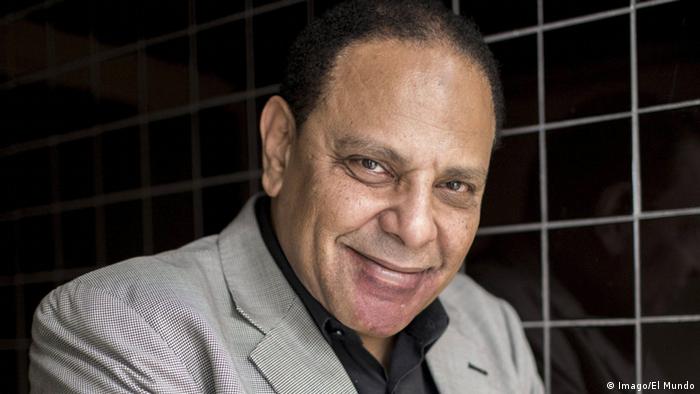
Alaa Al-Aswani is one of Egypt's leading public intellectuals.
I transcribe his weekly columns at Deutsche Welle

to my blog for future reference. 
Miss Farah al-Hajji is a 24-year-old Swedish citizen who was born in Sweden to an immigrant family and because a Muslim joy frequented the mosque to learn the principles of religion. There are many mosques in the West that are spent by Wahhabi (official and private) associations from the Gulf, which has led to the emergence of Islamic militants even among those born in the West. Ms. Farah received the teachings of Wahhabi Islam and wore the hijab, which was not known before the Wahhabi tide supported by oil money. In Egypt, for example, women took off the Turkish burqa in the wake of the 1919 revolution and remained sober until the veil was first introduced by the Wahhabi sheikhs at the end of the 1970s. In the end, Farah became a veiled Muslim Swedish woman and because she was looking for work she went to interview a company to work as a translator.
ـــــــــــــــــــــــــــــــــــــــــــــــــــــــ
The corner of Abu Salem is an Egyptian village in the center of Abu al-Nimras, Giza Governorate. There is no difference between this village and the thousands of villages in Egypt, but there are very few residents of the village followers of the Shiite sect. The 66-year-old leader of the Shiite community, Hassan Shehata, does not hide his Shiite faith and treats the villagers with a gun and no problem, according to security reports.
ـــــــــــــــــــــــــــــــــــــــــــــــــــــــ
Before Ms. Farah started the interview with the committee that she would test for the job, the chairman of the committee greeted her and extended his hand shaking hands, but Farah did not reach out to shake it and put it on her heart.

- I am sorry I can not stand you because my religion prevents me from shaking hands with men.

The Salafist Society (Wahhabism) has a strong influence in the village of Abu Musallam and controls all mosques in the village. The Salafi sheikhs in the Friday sermon launched a sweeping attack against the Shiites of the village and accused them of infidelity and insulting the companions of the Prophet (peace and blessings of Allaah be upon him). Around the village, the sheikh was denounced and cursed, and days later the news spread among the villagers that Hassan Shehata would come to visit his Shiite friends in the village.
ـــــــــــــــــــــــــــــــــــــــــــــــــــــــ
The Swedish company excluded Farah from the job and based her exclusion on a legal reason that her refusal to shake hands with the men was a breach of Swedish law that prohibits discrimination in treatment between men and women, whatever the reasons. Another logical reason the company did not mention was that having an employee dealing with the public and refusing to shake hands with men would lead to daily problems and embarrassing situations that would definitely affect the company's business. Ms. Farah was not satisfied with the company's interpretation of her exclusion and filed a complaint with the Anti-Discrimination Authority in which she asserted that her exclusion from the job was considered persecution because she was a Muslim.
ـــــــــــــــــــــــــــــــــــــــــــــــــــــــ
As soon as Hassan Shehata arrived at the house of his Shiite companions until the anger prevailed in the village of Abu Salim and hundreds of villagers demonstrated shouting against the infidels and then besieged the house where the Shiites gathered (and they numbered four) and threw the house with bottles of Molotov cocktails to burn it, but the house did not The four Shiites burn and seek refuge in the police, but they fail to protect them. The villagers resorted to another method. They came with huge hammers and digging tools, climbed the roof of the house and began to dig with enthusiasm to make a gap.
ـــــــــــــــــــــــــــــــــــــــــــــــــــــــ
The Anti-Discrimination Commission referred Ms. Farah's case to the labor court in Sweden, which held hearings to hear Ms. Farah's complaint and the statements of officials in the company that refused her appointment.
ـــــــــــــــــــــــــــــــــــــــــــــــــــــــ
The attackers finally managed to make a hole in the roof of the house and took it inside and grabbed the four Shiites and beat them with sharp instruments they had prepared. The Shiites continued shouting, begging and begging, but Balagdawi continued to beat them and drove them out to the waiting crowds abroad. As soon as the villagers saw the four Shiites, they shouted "Allahu Akbar", "Shiites, the enemies of Allah."
ـــــــــــــــــــــــــــــــــــــــــــــــــــــــ
The Swedish court ruled in favor of Ms. Farah and considered the incident against her a religious discrimination and said in the ruling:

"The complainant (Miss Farah) believes in explaining what her religion prevents her from shaking hands with men unless they are members of her close family and therefore her refusal to shake hands with men is a religious practice protected by Swedish law and the European Declaration of Human Rights."

The court has awarded a fine of four thousand three hundred and fifty dollars that the company should pay to Miss Farah in compensation for the injustice she has committed against her.
ـــــــــــــــــــــــــــــــــــــــــــــــــــــــ
The four Shiites died of the beatings, not only killing the villagers but tying their bodies with ropes and transporting them and blood bleeding profusely in the streets of the village. The village men grew up with joy to kill the Shiites, while the women of the village were singing.

"The parents did not show any remorse or shame about the incident, but the youth of the village were exchanging video clips of the four Shiites proudly and clearly. The teacher Mohammed Ismail said sitting in front of his house:

- We are happy with what happened. We hoped it would happen a long time ago. "
ـــــــــــــــــــــــــــــــــــــــــــــــــــــــ
Dear reader
I have listed two facts to you . One occurred in Sweden to Ms. Farah last week and the other occurred in 2013 in an Egyptian village . I hope you read the two facts carefully and then compare them until you reach the result you see and send to me . Thank you so much


Democracy is the solution

Tuesday, August 14, 2018

Alaa Al-Aswani: Is Hypocrisy in the Nature of Egyptians?


Alaa Al-Aswani: Is hypocrisy in the nature of Egyptians?

August 14, 2018

Alaa Al-Aswani is one of Egypt's leading public intellectuals.
I transcribe his weekly columns at Deutsche Welle to my blog
for future reference. This week's remarks are a grim echo of a
similar level of hypocrisy in America as elected representatives
in both parties seem oblivious to the antics and moral turpitude
of our current president.   
The announcer was talking to a well-known journalist on a television show. The dialogue touched on the achievements of the Sisi and the two vied to praise her.
"Can i say ..?"
Panic appeared on the face of the announcer and he ignored her question and continued to praise Sisi, but she interrupted him saying:
"Please allow me to criticize the Sisi president."
He said in a low voice:
"Go ahead."
Here the journalist said:
"I want to criticize the Sisi president for two reasons: first because he no longer cares about his health. He is exerting superhuman effort to save Egypt, but he must give himself a chance to rest. I feel very sad whenever I see the face of his sovereignty pale and tired of the multitude of work."
The announcer breathed a sigh of relief and released his reports and then said:
"What is the second criticism?"
The journalist said enthusiastically:
"Second, critical aspects of the Sisi's sovereignty, because he kidnapped our hearts, we Egyptians, there is no place in our hearts for another love. We love the sissy.

This advanced level of professional hypocrisy may not be the same in many countries and it seems that with the large number of hypocrites, it is on the Sisi to agree to be new and creative. Yesterday I read an article by a young journalist who preaches that the more Sisi laughed on television, the more the Egyptian stock market rose so immediately that with each new laugh of the Sisi, the Egyptian economy is winning 4 billion pounds. [Note -- see video below.]

I do not think any economic school in the world connects the stock market to anybody's laugh, but it's a model of creative hypocrisy. Hypocrisy is not limited to Sisi, but extends to every job holder. He hopes to treat the subordinate as his manager in our country. He often praises him and always feels that he is a genius. He may spying on his colleagues and convey their news to his manager to get his satisfaction.

The hypocrisy does not stop at the praise of the director and the president. We had a land in Upper Egypt that was illegally appropriated by some people and when we filed a lawsuit to recover our land, we were surprised that most of the neighbors recognized our right to land but refused to testify before the court "to avoid problems." Last week, some friends alerted me to the fact that a university professor had raided several lectures I gave on dictatorship (all recorded and on YouTube). The professor of fine arts transferred my lectures to text and crafts and published them in two essays as his own.

Strangely, some of those who warned me about this blatant theft and strongly denounced it, did like our neighbors in Upper Egypt. They asked me not to tell anyone that they warned me to steal because they did not want problems. The silence on the right and the defense of falsehood and negative in the face of injustice and lying to give safety and flatter the heads .. All applications of hypocrisy is spreading in Egypt now more than ever before, which leads us to ask:

"Is hypocrisy nature in the Egyptians ..?"

The answer is categorically denied. The Egyptians have proved repeatedly in modern history that they are no less courageous than any other people. They fought in defense of Egypt in several wars and fought in defense of their rights in two great revolutions in 1919 and 2011. Why do the Egyptians then agree? We can not understand the phenomenon of hypocrisy in isolation from the political context. The ruling regime in any country is the one who gets out of the people better or worse.

Masri is hypocritical because he is simply totally desperate to achieve justice. He agrees because he knows for certain that efficiency does not necessarily lead to success and hard work does not necessarily lead to promotion and quality education is not a requirement for jobs and that the law applies only to the weak, but the "mighty", the laws are changed to protect them. The Egyptians know that the word of truth has become a heavy price and they are often unwilling to pay it.

The announcer who agrees Sisi knows that his future and the survival of his dependents in the hands of the security services controlling the media, even if he said the right or short in the hypocrisy of Sisi, he will lose his work immediately and there are hundreds of broadcasters hypocrites dream of taking his place. The journalist who complains that Sisi has kidnapped her heart knows very well that her words will bring people's contempt but will also bring the satisfaction of the authority that will open the doors of the future wide .. In democratic countries, citizens do not need to exercise hypocrisy because the rules are fair and the reasons lead to results.

If you work hard, you will go ahead and if you learn well, you will definitely get a job and if your manager gets angry, his hand is not absolute in your abuse because there are regulations that apply to everyone, including your manager. The citizen in a democratic country is not afraid to say the truth is not because it is more encouraging than the Egyptians, but because it is reassuring to protect the law applied by an independent judiciary equal between the big and the small.

Of course, we do not defend the hypocrites and do not ask them for excuses, but hypocrisy is not just a moral flaw, but a social phenomenon linked to the ruling regime. It is naive to imagine that we will get rid of hypocrisy through religious and moral preaching because hypocrisy is not the disease but rather a symptom of tyranny. When we get rid of tyranny and establish a real democratic system, Egyptians will not need to exercise hypocrisy because they will live in the protection of the law and will all be governed by fair rules that respect efficiency and effort and are given to everyone who is entitled.

Democracy is the solution


Go to this previous column for a fuller explanation of Sisi's laughing.
"You keep riding cars and doing that Kiki miki thingy," Sisi said before bursting out laughing at his own joke, when speaking about the reasons for Egypt's failed economy.
The audience at the university - presumably feeling like they had no choice - laughed along at the autocrat's joke. Sisi then turned around to the oil minister and jokingly said: "Hey, Engineer Tarek raise the price of petrol and don't worry," before he continued laughing.
Sisi's joke came as he discussed ways to repair the Egyptian economy. He accused the Egyptian people of being lazy and not living up to their promises to him. Sisi claimed Egyptians are not working hard enough and too busy interacting on social media - such as with the Kiki challenge - rather than doing "their bit" fixing the sluggish economy.

Tuesday, August 7, 2018

Alaa Al-Aswani: Why did Sisi laugh at the dance of Kiki?


In his essay DW Arabia, Alaa Al-Aswani asks why did Sisi laugh at the dance of "Kiki"?


Alaa al-Aswani is a tireless advocate for democracy in 
Egypt. He speaks to all who seek more democratic 
alternatives to authoritarian systems.
My late father Abbas al-Aswani was a well known writer and lawyer who, like his generation, participated in the struggle against the British occupation and was repeatedly arrested. My father's family lived during the 1940s in a large two-story house on Reda Street in Sayeda Zeinab. My grandmother told me that she always received the officer who came to arrest my father in the sitting room in the first floor and urged him to remain calm until my father woke up without fearing Khutah .

My grandmother asserts that the officer was responding to her request and even apologizing to my father for following instructions. He was never subjected to torture. He usually spent the first night in the office of the department commander, talking to the officers who were addressing him as "Mr. Abbas."

When my father was arrested on trumped up charges, he participated in the Cairo fire and remained imprisoned for months in the foreigners' prison. He was never subjected to torture. He even participated with his fellow detainees in football matches and performed theater performances. The hot food came daily from the house. The same humane treatment as the late President Anwar Sadat when he was imprisoned in 1946 during his trial for involvement in the assassination of Amin Othman (finance minister in the government of the delegation) Sadat complains in his memoirs of two incidents Consider them to be The prison administration delayed handing over his personal bag, which led to the shaving of his chin and the washing of his teeth, and the other incident when awakened by the prison officer during the night and drove him out in the yard to face some of the accused and the atmosphere was cold enough to harm his health.

The Egyptian state treated the political prisoners until the military took control of Egypt in 1952. The military intelligence controlled the detention centers and began torture with electricity, police dogs, beatings, suspension and maltreatment. This brutal repression led to the killing of many of the most prominent fighters, Cambridge University graduate Shahdi Attia El Shafei He died of torture in 1960. Nasser was the first founder of the powerful machine of repression that crushed his opponents from all political directions. The repression machine did not stop one day with the succession of presidents over Egypt even during the year in which the Muslim Brotherhood took over. The soldier died of torture and the Brotherhood government claimed he had died in a car accident. We also recall how Mursi praised police officers who killed dozens of demonstrators who objected to the Port Said massacre.

Dozens of reports from independent international and domestic organizations confirm the horrific torture of detainees in Egypt. The crime of these only detainees is that they are opposed to Sisi or are not impressed by his genius and his nobility. We have to defend the rights of detainees as human beings regardless of their political orientation. Dr. Abdel Moneim Abul-Fotouh, 66, is suffering from slow death because he needs medical care after suffering from angina. He can not stand before the judge who allowed him to sit. 45 days and refused to refer him to hospital. This is the crime of committing a crime committed by the Sisi regime against many detainees, depriving them of their right to treatment, such as blogger Wa'el Abbas, who suffers from heart trouble. He refuses to be presented with a doctor and Dr. Hazem Abdel Azim, who suffers from terrible pain in the bones of his legs.

What is happening in Sisi prisons is a crime against humanity and a disgrace will continue to pursue those responsible for the regime and all those who are silent about this crime. In Egypt, something called the Human Rights Council appoints members of the regime and gives them generous salaries. Unfortunately, they do nothing serious to stop the regime's crimes against the detainees. Al-Sisi's intelligence department confirms that thousands of detainees are terrorists and therefore they have no rights. This fascist theory ignores several facts: that the accused is innocent until proven guilty and that the rights of prisoners in civilized countries are not affected by the charges against them, and there is a big difference between the state and the gang. The state carries out the law against the perpetrators of the crimes.

In the midst of this tragedy that is happening to thousands of detainees, we were surprised at Sisi at the youth conference talking about the dance of "Kiki" and laughing. I do not understand how Sisi is responsible for the suffering of thousands of people in prisons and he seems so unperturbed and happy. Why did Sisi laugh at Kiki?

Democracy is the solution

~~~~~

Al-Aswany, like most Egyptians, is not amused by Sisi's insensitive joke, blaming serious food and other shortages on people not working hard enough, implying they are having too much fun playing and dancing. 
This is from The New Arab:
Egypt's obsession with the Kiki dance is to blame for the rise in gas prices and the failing economy, according to President Abdel Fattah al-Sisi. During an "Ask the President" conference at Cairo University, Sisi mocked the viral Kiki challenge, which has swept social media. The challenge consists of dancing outside a moving car to Canadian rapper Drake's "In My Feelings" song, which has led to the arrest of a number of Egyptians and bans enforced across the region. 
"You keep riding cars and doing that Kiki miki thingy," Sisi said before bursting out laughing at his own joke, when speaking about the reasons for Egypt's failed economy.
The audience at the university - presumably feeling like they had no choice - laughed along at the autocrat's joke. Sisi then turned around to the oil minister and jokingly said: "Hey, Engineer Tarek raise the price of petrol and don't worry," before he continued laughing.
Sisi's joke came as he discussed ways to repair the Egyptian economy. He accused the Egyptian people of being lazy and not living up to their promises to him. Sisi claimed Egyptians are not working hard enough and too busy interacting on social media - such as with the Kiki challenge - rather than doing "their bit" fixing the sluggish economy. Cairo's disapproval of the Kiki Challenge is nothing new. Last week, state media threatened participants of the game with jail for breaking the country's - somewhat lax - traffic laws. 
Muslim scholars in Egypt also warned that the dance is a threat to country's "long entrenched values and ethics". Despite the fact that Sisi is blaming Kiki for keeping Egyptians too distracted from repairing the economy, Drake's famous song has sunk further into the political bloodstream of Egypt with an Arabic parody. The song lyrics express discontent with Sisi's rule and his regime's inability to raise living standards - despite his constant promises to create more jobs and wealth for Egyptians. 
"Sisi, listen to me, stop joking, we are dying, our leader," says the singer, pairing the song's light hearted beat with sombre lyrics in a desparate plea.
"Sisi, did you not promise that you will spoil us, our leader." 
The song also parodies complaints of the rising cost of staple goods - such as bread and fuel, which have become unattainable for many Egyptians. It also described Egyptians trapped in a state of depression due to rising poverty. The parody reflects a number of discontents expressed by Egyptians, which have been brushed off by the country's political and religious elite.
Earlier this month Ali Gomaa - a cleric the Egyptian state heavily relies on for stanch support - defended Cairo's crippling austerity measures by mixing his religious credentials with a bizarre take on nutrition in a recent TV interview. "You all complain that meat is too expensive and you say 'oh so what are we going to eat?'" he said.
"No, we shouldn't be talking like that! Allah created us needing 3,000 calories a day... 3,200 calories a day." He then went on to completely disregard basic nutrition advice and spoke about the calories in cake, saying this is a suitable alternative to meat.
"A piece of cake is 900 calories. So if you ate two pieces, that's it, as if you have eaten breakfast or dinner or whatever else." 
Despite Egyptian political and religious officials treating poverty in the country as a laughing matter, statistics show that poverty in Egypt is far from a joke. According to UNICEF, poverty levels in Egypt have reached 27.8 percent, putting children at significant risk. The UNICEF report, released at the end of last year said at least 10 million children are suffering as a result of "multi-dimensional poverty" and the physical and mental well-being of the population, with reports of children being affected by stunted growth due to malnutrition.

Sunday, August 5, 2018

Children Are Being Killed

This is a read and reflect essay. When two grandchildren are part of the household it's impossible to overlook policies and events involving children. Perhaps that's why I'm touchy about the death of kids. The response to the Valentines Day shooting in Florida is an ongoing reminder of the murder of kids and its impact on everybody. 
This essay by Gerard Vanderleun was written fourteen years ago in response to a school massacre in Russia resulting in the murder of over three hundred kids. School shootings in America have resulted in about the same number of victims since then, so this essay, reflecting on the impact of a child's murder, has a new and horribly timeless resonance. The difference between the Beslan massacre and our own is that America appears to have accepted the murder of school children as part of the school experience. Active shooter drills are as routine as fire drills but categorically different since fires are truly accidental and school shootings are deliberate killing. 

Pieta for the 41st Photograph

September 4,2004 -- In another place and time.
The boy that lies in his father's lap covered with crusts of blood gazing upward at nothing, nothing at all except his own pain. 
The soldier with the unlit cigarette carrying the little girl in filthy underwear with a long smear of blood across her nose and down her chin.
The child's small hand with the dry pool of blood in the palm and the small gold crucifix lying in it.
The stretcher being run past the camera carrying what might, under the burns and the blood, be a young girl.... and another, and another, and another, and another, and another.... 
I began to gather these images yesterday, I think. Or was it the day before? I'm not really sure. The cascade of outrages, the piling of atrocity on top of atrocity, has become so unremitting that it is sometimes difficult to know where one episode of evil ends and another begins. 
The waves keep coming and, because they are always to your back, they keep slamming you down into the hardpacked sand. You pick yourself up and spin around to face the next wave, but this sea of evil is cunning and the next wave will always come from behind your back no matter which direction you face. All you can know now is that there will be another one, and it will come at your back in the way the bullets came for the backs of the children in Russia. 
Because I am both too old and too distant to either pick up a weapon to defend, or offer help and comfort to the wounded or the dying, I am forced back on silly, futile, small gestures such as gathering images of the atrocities. In this I disgust myself and, like those who did not stand with Henry, hold my manhood cheap.
I thought that, perhaps, I could gather enough of them and arrange a kind of gallery as a testament, my own small memorial, to the children who were shot in the back or otherwise slaughtered by the diseased "militants" who thought nothing of these lives taken for their vile cause and their vile god. Somehow I would, I imagined, at least bear my own small witness among the millions of others doing the same around the world tonight. 
And so I collected the images. I selected ones that showed the fascist smirk that always rises dark above any slaughter of innocents. I selected ones that revealed the courage of those who would try to rescue them. I found and saved some that revealed the chaos and sharp edge of the moment when all that a child may have in front of him is ripped out of him. I saved 10, saved 20, saved 40 and then came to the 41st and stopped. 
I stopped because in that one image, grainy, indistinct and from the far side of the world in a situation I could not imagine, I saw the one thing I was not expecting to see at all.
No, that's not it. It was not what I saw but what I recognized.
What I recognized was something that I could not see in the picture, but a recognition that came to me through the picture. I knew it immediately and at such a deep level that my first reaction was to look away, to go on to the next picture no matter what it was, to determine to never look at the 41st picture again. 
But of course I did. I did because I had no choice. I had no choice because within this one picture I could see two separate episodes of my own life somehow together in one image that depicted an outcome that terrified me to the core of my being.
This is the picture I could not look at. This is the picture I must look at. I will try to explain -- not really to you, but to myself -- why it terrifies me more than all the other pictures. 
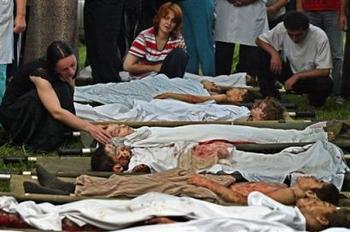
This is the image but Vanderleun's essay is more compelling. We
live in a time when images and memes are powerful but words
are often overlooked. In this case I lost track of the writer long
ago but I was reminded when I was visiting my old blog
long since abandoned.
She kneels among the dead children. She has long black hair pulled back and dresses in a loose black dress as she kneels at the head of her dead boy. She reaches out to touch, or perhaps arrange the hair, of her dead child. Her dark hair is parted in the middle and her arm seems to also be downed with dark hair. Her eyebrows too are dark and her skin olive. If I were to see this woman in another context, in a different and less death dominated photograph, at this focus and at this distance, I would think, for at least a long moment, that I was looking at my first wife. 
She had this build, this coloring, the predilection for black clothing, and even an echo of the features of this woman since her ancestors came to America from the Balkans. She too would pull her hair back so. And she had, as I recall, the same ability to make a gesture that was at once strong and yet gentle when reaching out to touch our daughter when she was as young as the small dead boy that this woman caresses. 
The life I had with my first wife was all long ago, and now I live far away in time, space and spirit from that woman as well as from that daughter. Now my life's setting is a small town, an ocean to the west, and a woman as different from my first wife as the sun is from the moon. And someone else as well. 
In this life there is, to my continuing delight, a child. He's bright and funny and breathtakingly striking ten-year old boy so topped off with life and joy that he can stop your heart. At the present time, my step-son is fond of Nintendo, not at all fond of girls, keen for a swordfight about every ten minutes of his waking life, and both depressed and elated at the advent of the 5th grade at the opening of his school next week. If I could show you a picture of him you'd agree that he's a very promising young man.
And I can show you a picture of him. 
He's up there, just above, my first wife's hand is touching him. Look carefully. You'll see him and her both. Together in one instant, in one impossible image. 
If you are a parent, you know as all parents know, the single darkest and most secret fear of all. You know what I mean. Yes, that one. The one we never mention. The fear that it is forbidden to speak of. The one we don't speak of ... ever. The one that we push out of our thoughts before it even finishes forming. It is the fear you see there in that photograph. The photograph that shows you looking down at your murdered child.
That's what I saw in the photograph. I saw a wife and a son -- not mine, I knew, but mine just the same -- frozen forever in an instant that I prayed would never come to me, that would remain just what it was, a photograph of a woman and a child I recognized but did not know. 
At some point in the last few days, I put my arms around my wife as we both looked out the kitchen window. From our small window you can see across the green and brindle hills down to the ocean where the slow Pacific swells roll onto Main Beach where a volleyball game is always on the schedule and the seagulls and surfers share the waves.
"Every single day," I said, " I thank God above that we are all here, in this good place, close to each other and still kept safe from things like those going on in Russia."
Next week my stepson will walk up the hill and take the bus to his first day of school. Seats will be assigned. He'll be given books and lists of supplies he must have. Nothing unusual will happen. In the afternoon, he will come home. My wife and I will have dinner with him, he'll do his homework and go to bed. It will be like that day after day. An ordinary life in an ordinary town in an ordinary time. 
And the years will flow by and he'll go from strength to strength, from one bright moment to the next. His mother and I will watch him move ever upward into life as he gradually grows away from us and into his own life. This is how it was meant to be and how it will be. He will never be found in a photograph like the one I saw today. There's no place for him in the 41st photograph, the one I couldn't look at but saw just the same. 
I am willing to do anything, anything at all, no matter what it may be, to keep him out of that photograph. That's my answer to what I saw. My question is, "Are you?"

I need to mention that the Beslan School Siege has quite a long Wikipedia article. A word search for "Putin" returns 47 hits. Twenty are in the footnotes but the rest are part of the narrative. No, he wasn't a participant, but his decisions affected what happened.
Does anyone need reminding that Vladimir Putin has been associated with murder in one way or another for eighteen years? Thanks to diplomatic language and protocols that word is never used regarding people in high places, but just as leaders expect and deserve credit for their successes, so must the responsibilities of horrible events, intended or unintended, also carry their name.
History will argue for years about Putin's role, but his political power seems not to have waned in the years since.
The handling of the siege by Vladimir Putin's administration was criticized by a number of observers and grassroots organizations, amongst them Mothers of Beslan and Voice of Beslan. Soon after the crisis, the independent MP Vladimir Ryzhkov blamed "the top leadership" of Russia. Initially, the European Union also criticized the response.
Critics, including Beslan residents who survived the attack and relatives of the victims, focused on allegations that the storming of the school was ruthless. They cite the use of heavy weapons, such as tanks and Shmel rocket flamethrowers. Their usage was officially confirmed.

Tuesday, July 31, 2018

Alaa Al-Aswany: Do You Know Miss Eileen Erson?


Three reasons for the emergence of Miss Eileen Erson
In his article for DW Arabia, Alaa Al Aswani is known for his reading of what Miss Eileen Erson did in Sweden.
Alaa al-Aswani is a tireless advocate for democracy in 
Egypt. He speaks to all who seek more democratic 
alternatives to authoritarian systems.
July 24, 2018

Do you know Miss Eileen Erson?

Often you do not know it because the Egyptian media of the intelligence did not mention anything about it, but focuses on the news of football players and the grams of movie stars and singing and most importantly the great achievements of the unique achievement of Sisi President genius.

Eileen Erson is a Swedish girl in her twenties who studies social work at the University of Gothenburg and has volunteered to help refugees who have poured into Sweden to escape war zones. The issue of refugees raises a dispute between the Swedes. Human rights defenders consider sheltering refugees a humanitarian duty and an obligation under international law, but punishing terrorist acts that kill Westerners in the name of Islam has helped right-wing parties persuade Swedes to close doors to refugees. The Government of Sweden has begun to pursue the policy of forced removal of asylum-seekers after their applications have been rejected. Human rights activists objected but the Swedish government was not obliged to oppose them and continued forcibly repatriating the refugees.

Activists learned that a 52-year-old Afghan refugee would be forcibly deported from Gothenburg to Turkey and from there to Afghanistan. Eileen Erson bought a ticket on the plane and installed it. When the pilot asked passengers to sit in their seats and tie the belts ready to take off, Eileen opened her mobile phone live on Facebook and announced that she would only sit down after the Afghan refugee who was forcibly deported. It was impossible for the pilot to take off before Eileen sat down and the passengers split between supporters and opponents of her position. A passenger with an English accent on Elaine tried to grab her mobile phone but stopped him and shouted at him.
Which is the most important thing you have to save a human life or your jet lag? I am here to save the life of a man who will be forcibly deported to Afghanistan where he will be killed there.
Airport authorities announced that they would not use violence to force Ellen to sit down and soon the authorities decided to drop the Afghan refugee from the plane. The passengers met the decision with applause as Eileen cried and said:
I am happy because I have done my human duty.
Eileen has become a champion of social networking, but right-wing members have been angered as they prepare to sue Eileen for disrupting the plane, fining her a fine or imprisoning her for up to six months. I trust that Ellen will face her trial bravely and will use her to defend the refugee issue. What Eileen did is great and the source of greatness is not only her courage and her political awareness but the extent of her humanitarian commitment. People usually defend the rights of those who share religion or nationality. But a Swedish Christian girl defends an unnamed Afghan Muslim man and challenges her country's immigration laws to save his life. The affiliation to humanity that Eileen represents is the highest type of belonging because it defends human rights merely because it is a human being regardless of religion and gender. Why did a girl like Eileen appear in Sweden and seldom appeared in Egypt. There are three reasons for Eileen's appearance:

First: the rule of law

Sweden is a democratic country where the law applies to everyone from the head of state to the most basic citizen. Human rights are reserved there, will not be arrested Eileen will not be beaten and tortured with electricity in the security of the state will not be fabricated charges because the Swedish judiciary is not prestigious but an independent judiciary and therefore when Elaine took this position in the plane was aware that it is in the protection of the law.

Second: Public freedoms

The media in Sweden is not affiliated with intelligence, as is the case in Egypt, but it is an independent free media whose job is to convey different views so that the citizens will have their views on real knowledge. The demonstration and holding meetings and addressing the masses are fundamental freedoms protected by Swedish law. Because it participated in a demonstration and the Swedish parliament is elected impartially and it reflects the will of the people, and its function is to hold the government accountable, not like the Egyptian parliament, which was formed in the intelligence offices to be the main function of approving the president's decisions and congratulating him on holidays.

Third: Civil State:

Sweden is a civil state governed not by religion or militarily and it respects the religions of all citizens. Thus, Eileen has come to realize that all human beings and their religious beliefs must be accorded the same respect. If Elaine had originated in Egypt or an Arab country, she would have heard the Friday preachers call for healing for the sick of Muslims only and consider non-Muslims infidels that should never be equated with Muslims. Eileen would certainly hear lessons about the principle of "loyalty and innocence" imposed on a Muslim loyal to Muslims only and impose on him hatred of non-Muslims and prevent him from their loyalties and not become like them with God, and Eileen will also learn that the resurrection will not even Muslims Muslims beat the Jews and kill them all so that the stone He will say and say: "A Muslim there is a Jew who hid behind me ... kill him." These thoughts that are repeated every day in our societies prevent the formation of a tolerant and noble personality such as Elaine because we often learn religion in the context of hatred and not in the context of human love.

Eileen is the best human model of democracy, while hypocrites, cowards and fanatics are the natural product of fascist Arab military or religious regimes.
Democracy is the solution